Juvenicides In School: Experiences Of Adolescents From Visual, Sound And Creative Narratives
Keywords:
Juvenicide, Symbolic Violence, School, Social Representations, Creative NarrativesAbstract
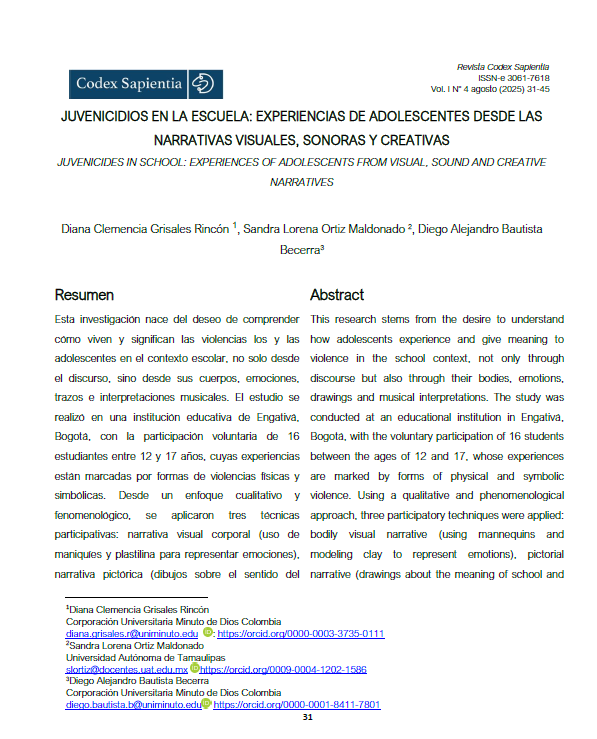
This research stems from the desire to understand how adolescents experience and give meaning to violence in the school context, not only through discourse but also through their bodies, emotions, drawings and musical interpretations. The study was conducted at an educational institution in Engativá, Bogotá, with the voluntary participation of 16 students between the ages of 12 and 17, whose experiences are marked by forms of physical and symbolic violence. Using a qualitative and phenomenological approach, three participatory techniques were applied: bodily visual narrative (using mannequins and modeling clay to represent emotions), pictorial narrative (drawings about the meaning of school and juvenicide) and sound narrative (creation of original verses and songs). These songs, born from emotion, protest and desire, express resistance to imposed silence, institutional hierarchy and school dehumanization. The most represented emotions (anger, sadness, fear, frustration) reveal that school can also be a place of pain. However, within these narratives emerge hopes for change, dignity and tenderness. This study advocates for a pedagogy of recognition, where youth art becomes a legitimate means to narrate, heal and transform.
Downloads
Downloads
Published
How to Cite
Issue
Section
License
Copyright (c) 2025 Codex Sapientia

This work is licensed under a Creative Commons Attribution-NonCommercial 4.0 International License.
Codex Sapientia de Posgrado Centro Universitario Hidalguense A.C. proporciona acceso abierto a su contenido, basado en el principio de que ofrecer al público un acceso libre a las investigaciones asimismo esto permite un intercambio de conocimientos y generación de redes académicas para el desarrollo a nivel estatal, federal y global. También se hace hincapié que Codex Sapientia no cobra a los usuarios por consultar sus artículos ni a los autores para que publiquen sus manuscritos.
Codex Sapientia de Posgrado Centro Universitario Hidalguense A.C, cuenta con una Licencia Creative Commons Atribución-No Comercial- 4.0 Internacional (CC BY-NC 4.0), la cual permite al usuario copiar y distribuir el material en cualquier medio o formato.