Social Worker Intervention With Adolescents In The "Bénito Juárez" Antisocial Behavior Prevention Modules In Ciudad Victoria, Tamaulipas.
Keywords:
Social Work, Systematization, Adolescence, Social ExclusionAbstract
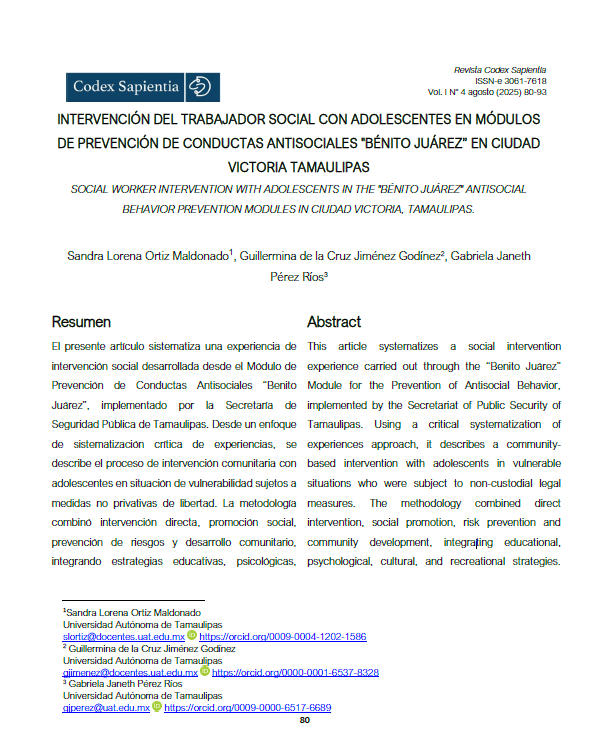
This article systematizes a social intervention experience carried out through the “Benito Juárez” Module for the Prevention of Antisocial Behavior, implemented by the Secretariat of Public Security of Tamaulipas. Using a critical systematization of experiences approach, it describes a community-based intervention with adolescents in vulnerable situations who were subject to non-custodial legal measures. The methodology combined direct intervention, social promotion, risk prevention and community development, integrating educational, psychological, cultural, and recreational strategies. Led by a social worker, the intervention was articulated through an inter-institutional network including entities such as DIF, CIJ, ITEA and CECATI 93, enabling comprehensive care. Among the main outcomes: 47 adolescents completed secondary school, 14 received specialized support, and several were referred for mental health and addiction treatment. Protective factors such as self-esteem, social participation and sense of belonging were also strengthened. The abrupt closure of the program revealed structural gaps in public prevention policies. Nevertheless, the documented experience offers a replicable model for urban contexts marked by high social exclusion.
Downloads
Downloads
Published
How to Cite
Issue
Section
License
Copyright (c) 2025 Codex Sapientia

This work is licensed under a Creative Commons Attribution-NonCommercial 4.0 International License.
Codex Sapientia de Posgrado Centro Universitario Hidalguense A.C. proporciona acceso abierto a su contenido, basado en el principio de que ofrecer al público un acceso libre a las investigaciones asimismo esto permite un intercambio de conocimientos y generación de redes académicas para el desarrollo a nivel estatal, federal y global. También se hace hincapié que Codex Sapientia no cobra a los usuarios por consultar sus artículos ni a los autores para que publiquen sus manuscritos.
Codex Sapientia de Posgrado Centro Universitario Hidalguense A.C, cuenta con una Licencia Creative Commons Atribución-No Comercial- 4.0 Internacional (CC BY-NC 4.0), la cual permite al usuario copiar y distribuir el material en cualquier medio o formato.