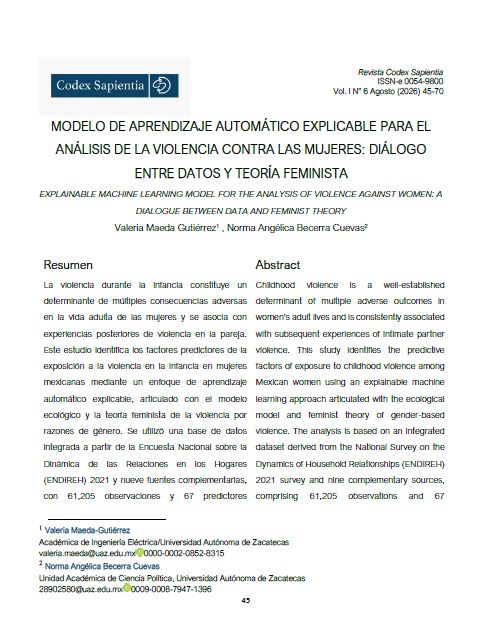
Explainable machine learning model for the analysis of violence against women: a dialogue between data and feminist theory
Keywords:
childhood violence, gender-based violence, machine learning, SHAPAbstract
Childhood violence is a well-established determinant of multiple adverse outcomes in women’s adult lives and is consistently associated with subsequent experiences of intimate partner violence. This study identifies the predictive factors of exposure to childhood violence among Mexican women using an explainable machine learning approach articulated with the ecological model and feminist theory of gender-based violence. The analysis is based on an integrated dataset derived from the National Survey on the Dynamics of Household Relationships (ENDIREH) 2021 survey and nine complementary sources, comprising 61,205 observations and 67 predictors organized across four ecological levels. A CatBoost model was trained using stratified partitioning, cross-validation based hyperparameter optimization, threshold calibration, and SHAP-based interpretation.
On the test set, the model achieved an AUC of 0.771 (95% CI: 0.760-0.781), with a sensitivity of 0.606 and a specificity of 0.792. The history of violence block accounted for the largest predictive contribution, with witnessed, sexual, and partner-related childhood violence emerging as dominant predictors. These findings support the hypothesis of intergenerational transmission of violence and highlight the potential of explainable models for analyzing complex social phenomena
Downloads
Downloads
Published
How to Cite
Issue
Section
License
Copyright (c) 2026 Codex Sapientia

This work is licensed under a Creative Commons Attribution-NonCommercial 4.0 International License.
Codex Sapientia de Posgrado Centro Universitario Hidalguense A.C. proporciona acceso abierto a su contenido, basado en el principio de que ofrecer al público un acceso libre a las investigaciones asimismo esto permite un intercambio de conocimientos y generación de redes académicas para el desarrollo a nivel estatal, federal y global. También se hace hincapié que Codex Sapientia no cobra a los usuarios por consultar sus artículos ni a los autores para que publiquen sus manuscritos.
Codex Sapientia de Posgrado Centro Universitario Hidalguense A.C, cuenta con una Licencia Creative Commons Atribución-No Comercial- 4.0 Internacional (CC BY-NC 4.0), la cual permite al usuario copiar y distribuir el material en cualquier medio o formato.