About the Journal
La revista Codex Sapientia de Posgrado Centro Universitario Hidalguense A.C, publica artículos de investigación, capítulos de tesis, estados de la cuestión y proyectos académicos, haciendo posible la divulgación científica multidisciplinaria de acuerdo a las líneas de investigación, aquí presentadas.
En Codex Sapientia se publican artículos originales de investigación científica disciplinarias, reportes de investigación o reseñas de libros en español e inglés, con el propósito de dirigirse a la comunidad científica del país, de la región y a nivel global.
Los artículos que se publican en la revista, son en formato HTML y PDF.
RIGUROSIDAD CIENTÍFICA.
La revista Codex Sapientia, publicada por Posgrado Centro Universitario Hidalguense A.C, es una publicación de carácter electrónica con arbitraje por pares ciegos, todos los manuscritos son evaluados bajo un proceso riguroso con expertos en la disciplina y en la línea de investigación.
Los envíos serán evaluados en primer lugar por el editor en jefe, posteriormente, si los manuscritos no cumplen con los requisitos mínimos (ver apartado sobre lineamientos para autores) serán rechazados, lo mismo si son investigaciones que no están dentro de las disciplinas que comprende la revista.
Current Issue
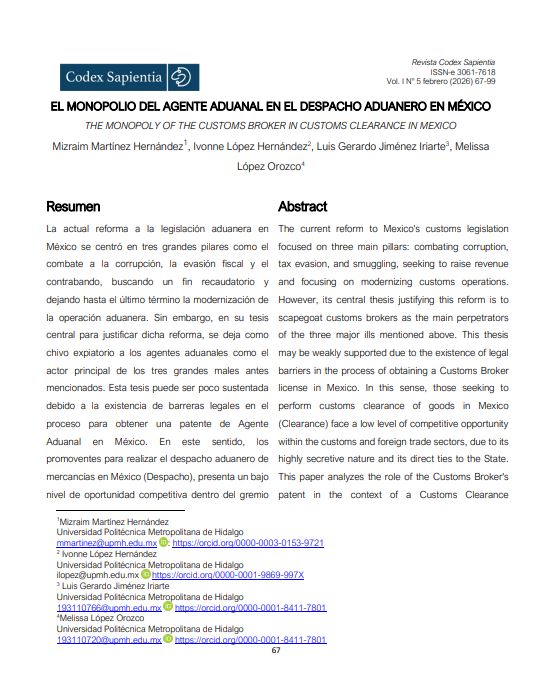
Vol. 1 No. 5 (2026): Justice and Transformation: New Coordinates of Mexican Law
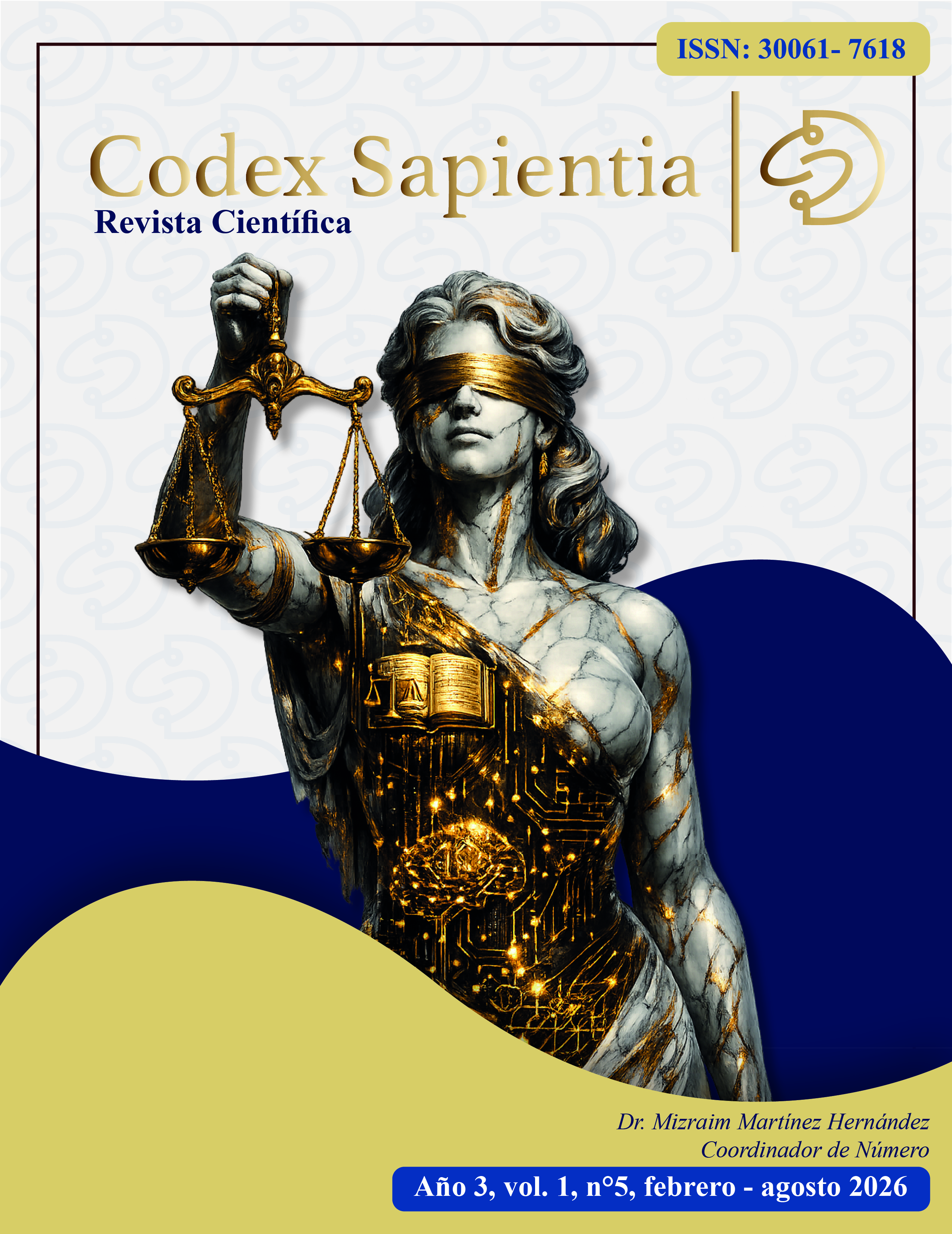
This issue of the Codex Sapientia Journal of Scientific Research and Dissemination is situated within the field of legal disciplines, approaching law as an applied social science that directly shapes the configuration of the State, the regulation of institutions, and the protection of rights.
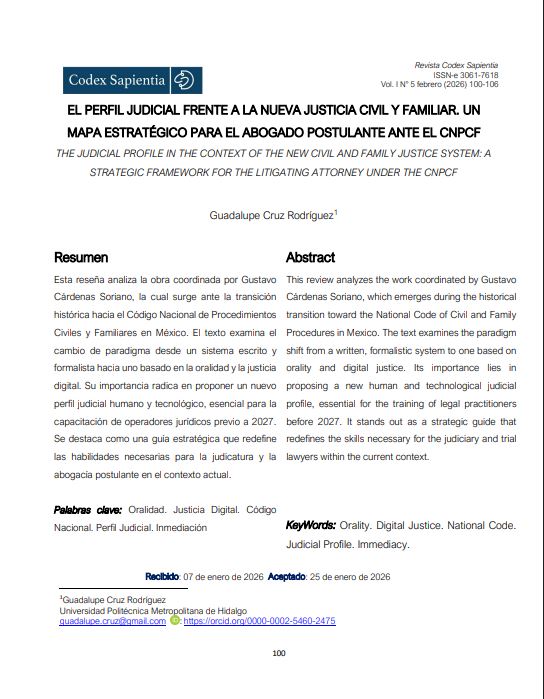
The works included in this edition analyze, from a legal perspective, structural issues within the Mexican normative system, with particular emphasis on customs law, criminal law, and recent transformations in civil and procedural matters. Through doctrinal, critical, and applied approaches, the contributions examine phenomena such as institutional corruption, limitations in competition within customs clearance, the effects of legislative reforms on procedural balance, and the scope of artificial intelligence in legal practice.
Likewise, this issue highlights the tensions between normative design and its practical implementation, underscoring the need to strengthen mechanisms of control, transparency, and efficiency in the exercise of law.
In this sense, the collective work presented here proposes an understanding of law not merely as a system of norms, but as a dynamic field in constant transformation, shaped by power relations, technological innovation, and processes of institutional reconfiguration.
Taken together, the texts contribute to a critical analysis of contemporary Mexican law and open avenues for discussion aimed at its improvement, in favor of a more equitable, functional legal system aligned with current demands.
Published:
2026-02-17